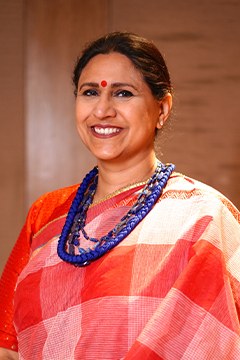
In a compelling and intellectually stimulating Tête-à-Tea session, Prabha Khaitan Foundation had the distinct honour of hosting His Excellency Philipp Ackermann, Ambassador of the Federal Republic of Germany to India, in an engaging conversation with eminent journalist Srinjoy Chowdhury. The dialogue, titled “India and Germany: Partners in Progress, Sustainability, and Innovation,” offered profound insights into the evolving contours of Indo-German relations; anchored in mutual respect, shared democratic values, and a collective vision for a sustainable and technologically advanced future.
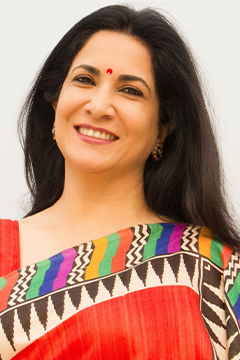
The session commenced with a gracious welcome note by Neelima Dalmia Adhar, Ehsaas Woman of Delhi & Honorary Convenor of Delhi NCR Affairs of the Foundation, whose eloquent words set the tone for an afternoon of erudite exchange and cultural camaraderie.
Recalling a moment of diplomatic spontaneity, Chowdhury narrated an anecdote from Prime Minister Narendra Modi’s visit to Europe: “Prime Minister Modi was in Stockholm when suddenly we were told to arrange something in Berlin. It turned out that Chancellor Angela Merkel had invited him to stop by Berlin on his way back.” Between 2014 and 2021, he noted, “Chancellor Merkel and Prime Minister Modi met about 12 or 13 times – more than Modi met any other world leader.”
Responding with warmth and humility, Ambassador Ackermann reflected, “The fact that they have met so often shows that there was a level of trust – a remarkable one, I would say.” He added that such frequent meetings underscored the “deep and strategic partnership” between India and Germany, a relationship that extends far beyond formal diplomacy. “In modern communication between heads of state,” he said, “there’s the telephone, WhatsApp, and texting, but the real measure of trust is how often leaders choose to meet face to face.”

Touching upon the perception that Indo-German relations often remain “below the radar,” the Ambassador smiled and remarked, “That may not be the worst thing. Look at the U.S.-India relationship; sometimes it’s in heaven, sometimes it’s out of heaven. Being below the radar is not necessarily a bad thing.” He emphasised that Germany’s ties with India are not defined merely by trade or technology, but by a profound cultural connection dating back to the 19th century. “Our engagement with India began through Indology,” he observed, “with scholars such as Max Müller, and others who studied Sanskrit, art, and Hindu philosophy. This cultural curiosity for Indian civilization remains deeply rooted in the German academic and artistic landscape.”
The conversation gracefully transitioned to education and student mobility. With his characteristic good humour, Ambassador Ackermann remarked, “I was afraid you’d move from the soft issue of Indian civilisation to Donald Trump; but I’m happy to talk about students!” He proudly revealed that “there are now 60,000 Indian students in Germany; by far the largest non-German group.” German universities, he added, “perceive Indian students as extremely dedicated, committed, ambitious, and hardworking.”
Highlighting Germany’s egalitarian approach to education, the Ambassador noted, “Higher education is a public good in Germany; state-funded and largely free of tuition fees. Even at the best institutions, students pay almost nothing compared to the exorbitant fees in the Anglo-Saxon world.” This, he asserted, was one of Germany’s greatest advantages and a reason why “more and more Indians are now choosing Germany as their academic destination.”
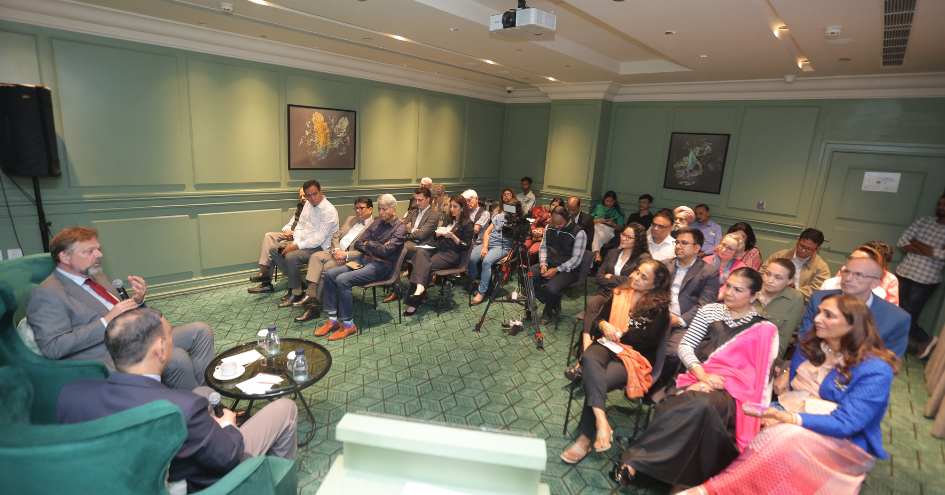
As the discussion turned to migration and employment, the Ambassador spoke candidly: “All Western countries; the U.S., Europe, and Germany; need skilled labour. Germany’s birth rate has been low for fifty years, and we are an ageing society. We need skilled migration; legal migration.” He invited Indian professionals to consider Germany, noting that opportunities exist not only for engineers and IT experts but also for “nurses, caregivers, and craftsmen.”
Discussing trade and investment, Ambassador Ackermann underscored the robust economic linkages between the two nations. “We have more than 2,000 German companies in India – not only giants like Siemens, which has been here since 1867, but also small and medium-sized enterprises that see India as a market they must not miss.” Yet he observed, there remains immense untapped potential: “Our trade volume with India is about €50 billion, while with China it is €300 billion. We want to increase this Indian volume, big time.”
Touching upon the pressing challenge of climate change, Ambassador Ackermann emphasised the indispensable role India plays in global climate action. “Without India, all combat is futile. We have to get India on board,” he remarked, underscoring India’s pivotal contribution to the world’s sustainability goals. Elaborating further, he highlighted the Green and Sustainable Development Partnership (GSDP) between Germany and India, describing it as “something that is not theoretical, it’s concrete.”
The conversation then took a reflective turn, as Ackermann spoke admiringly of Rabindranath Tagore’s philosophical exchanges with European intellectuals like Einstein and Heisenberg. “Tagore was a star when he came to Europe, a representative of civilisation who left a huge impression,” he noted, celebrating India’s enduring cultural influence.


Concluding on a lighter note, Ackermann quipped about sports diplomacy, acknowledging Germany’s footballing prowess and India’s cricketing supremacy –
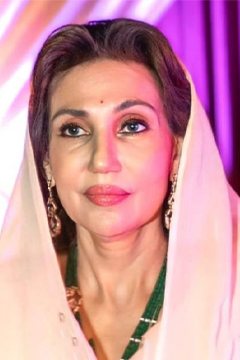
“India is probably the best country in the world in cricket, but the worst in football,” he smiled. The engaging Tête-à-Tea session concluded gracefully with Dipali Bhasin, Ehsaas Woman of Delhi, delivering the closing remarks, encapsulating the spirit of collaboration and dialogue between India and Germany. In a warm gesture of appreciation, Chowdhury and Ambassador Ackermann, were felicitated with exquisite puppets from Western India by Sonali Chauhan, General Manager of The Connaught, New Delhi – IHCL SeleQtions.
This session of Tête-à-Tea was presented by Smartworks; Hospitality Partner, The Connaught, New Delhi – IHCL SeleQtions