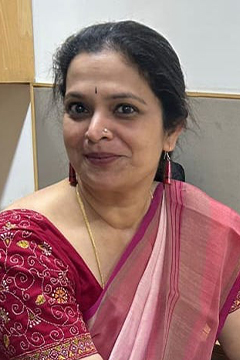
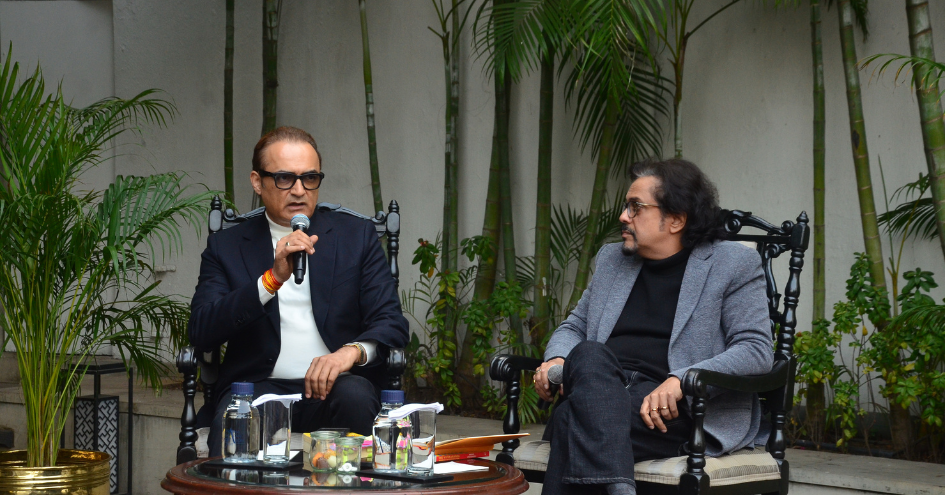
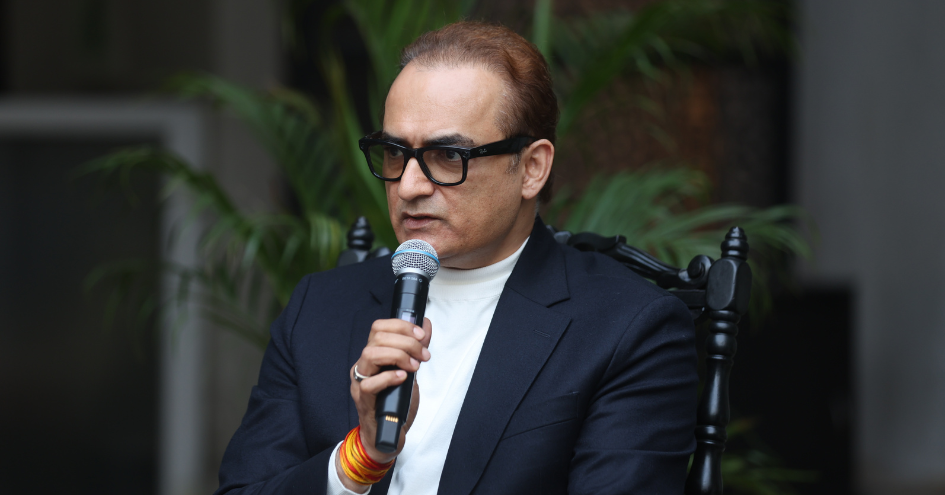
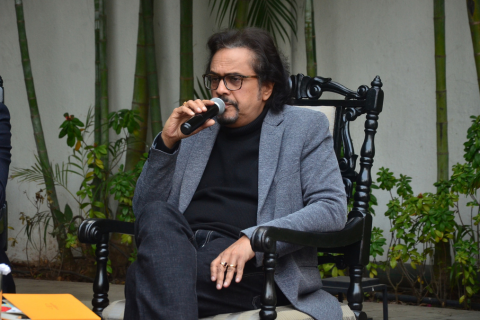
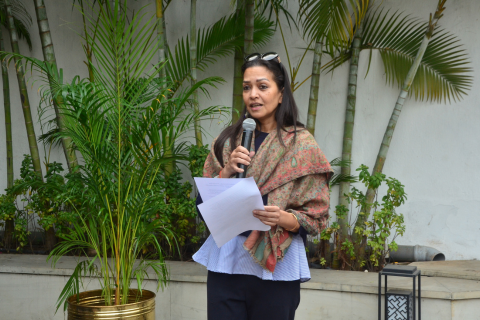
This session of An Author’s Afternoon in Kolkata unfolded as a luminous confluence of literature, philosophy, and music, featuring journalist and author Anshul Chaturvedi in a deeply absorbing conversation with tabla maestro Bickram Ghosh. The evening drew an eager and reflective audience, setting the tone for what became an intellectually stirring and emotionally resonant exchange. The session opened with a warm and gracious welcome by Esha Dutta, Honorary Convenor of North-East Affairs of the Prabha Khaitan Foundation and Ehsaas Woman of Kolkata, lending the evening with ceremonial elegance.
What distinguished the evening was not merely the stature of its speakers, but the candour and philosophical depth with which they engaged one another. Ghosh began by recalling his early encounters with Chaturvedi, observing with admiration that “he knew infinitely more about two iconic Bengalis than I knew; Swami Vivekananda and Subhas Chandra Bose.” Reflecting on this unlikely discovery, he added with gentle irony, “I’m a Kolkata boy, and as he himself says, the man from Noida knows much more than me.”
The conversation soon turned toward Swami Vivekananda’s relevance in everyday life. Ghosh highlighted the practical nature of Chaturvedi’s work, noting, “Very few books on Vivekananda are like handbooks which help you lead your life on a daily basis; we put our great leaders up there, make them esoteric, and don’t really use them in our daily lives, but here he’s written a book which you can use in your daily life.”
One of the most provocative moments of the evening emerged when Chaturvedi quoted Vivekananda’s line: “I do not care for human help.” Questioning its modern relevance, he asked whether this meant rejecting parental care, the nurturing mother, or the guiding guru. The dialogue unfolded with striking honesty as he observed, “We live in an era where hustle is seen as a virtue; social climbing is seen as a virtue; and we have internalised it that you have to be a hustler to move ahead in life.”
Central to the discussion was Vivekananda’s teaching that self-work precedes recognition. Chaturvedi quoted the monk’s wisdom: “When the flower blooms, the bees come of their own accord.” He interpreted this as a rejection of image-building and performative success: “You cannot take a plastic flower and sell enough PR for the bees to come for it. Work on yourself. Do not care for human help to elevate you.”
The conversation deepened into reflections on loss, fear, and impermanence. Chaturvedi remarked poignantly, “Happily ever after is only for film productions. There is no ever after. One of them has to mourn for the other. There’s no way around it.” His words resonated with quiet gravity as he continued, “The longer you live together, the more difficult the separation.”
Turning to religion and atheism, Chaturvedi offered a nuanced perspective: “You don’t have to be religious to understand Vivekananda. You can even be an atheist and understand him.” He argued that Vivekananda did not preach an abstract faith but insisted on experiential truth: “He is the only man who asked his guru, ‘Have you seen God?’”
He further critiqued transactional faith, remarking, “There is a beggar’s religion and a shopkeeper’s religion; which is transactional.” Such religion, he suggested, reduces the divine to a problem-solver for board exams and cricket matches, “which is really demeaning to the larger cosmos.” The discussion also ventured into fear as a formative human emotion. Quoting Vivekananda, Chaturvedi said: “Fear must be fought. Dissatisfaction must be welcomed. He who is afraid of loss always loses.”
Drawing parallels from sport and life, he explained that fear alters performance and diminishes potential, “You play not to lose, and so your game changes.” In one of the evening’s most lyrical moments, Chaturvedi quoted: “I am a spirit living in a body. I am not the body. The body will die, but I shall not die.”
When asked why humans do not remember past lives, he offered a practical explanation: “Imagine the complications if everybody remembered who they were before… God is a more practical manager of things than we are.” What endures, he suggested, are not memories but emotions: “You will carry your strongest emotions; intense love or intense hate; the rest you will forget.”
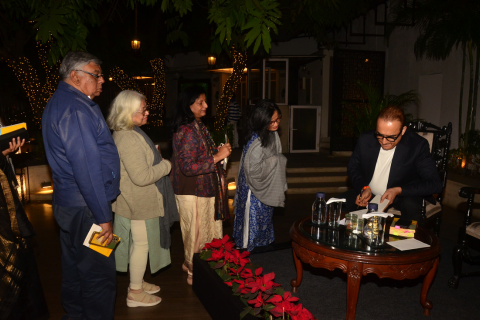
As the evening drew to a close with an interactive Q&A session, forgiveness emerged as a final and vital theme. Chaturvedi observed, “Forgiveness is one of the most essential qualities; there is a cleansing that happens.” His reflections transformed the dialogue into something more than a literary conversation; it became a meditation on how to live.
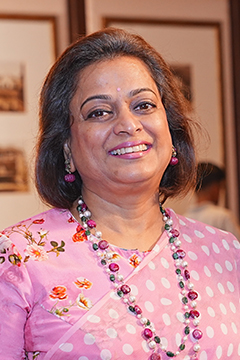
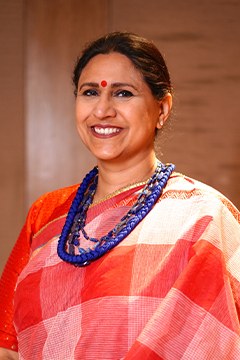
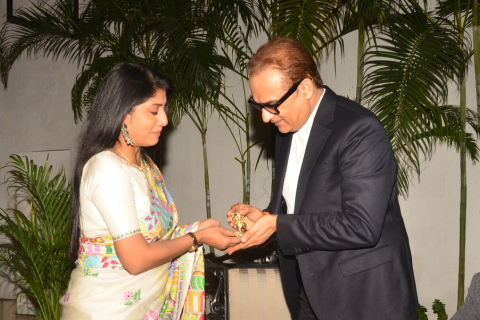
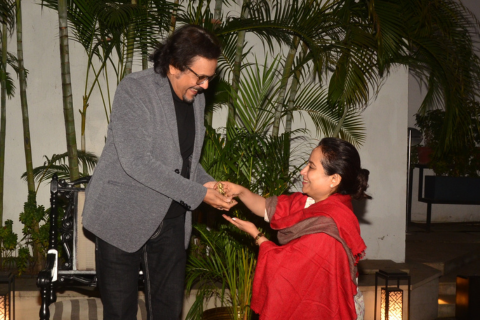
As Esha Dutta, Honorary Convenor of North-East Affairs and Ehsaas Woman of Kolkata, delivered the closing remarks, the author Anshul Chaturvedi was felicitated by Jaya Seal Ghosh, while conversationalist Bickram Ghosh was honoured by Ruman Ganguly with traditional Dokra artefacts.
This session of An Author’s Afternoon was organized in association with Hospitality Partner, Taj Bengal.